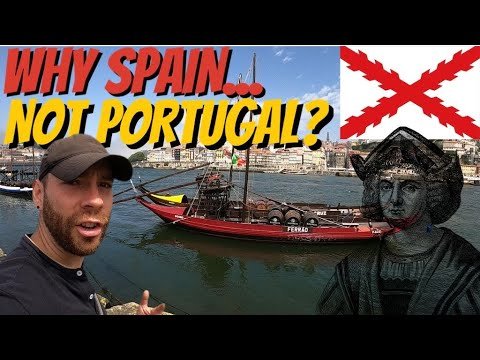
The Spanish Empire was on the greatest empires ever. This video explains how Christopher Columbus ALMOST sailed for PORTUGAL instead of SPAIN. Ultimately, King John II of Portugal denied funding to Christopher Columbus, resulting in and Queen Isabella and King Ferdinand (Catholic Monarchs) of Spain to do so.. forever changing the World we know today… What would have happened if Colombus sailed for Portugal?
Directly Support my Mission on Patreon:
Buy me a coffee or help support my channel and further adventures – Anything helps! :
Connect with me on Instagram:
FACEBOOK PAGE:
Adventure Elliot is a bilingual travel vlogger (English and Spanish) with a particular interest in the Spanish speaking world. I enjoy taking adventures – big or small – and my goal is to show the Spanish speaking world 1 video at a time.
The goal of my channel is simple yet complex: I want to document and share authentic & educational content of anything related to Adventure Travel, Geography, & Language in the Spanish-speaking world. It’s kind of a loaded topic, but it allows me to never exhaust my creative outlets. The truth is, I’ve always been extremely passionate about what I’m doing on my channel, but I never properly documented it when I started adventuring as a younger man in my college years. I’ve made over 150 Youtube videos in both English and Spanish, and I have aspirations to make 1000s more. If that sounds interesting to you, join the community and follow me along the way.. After all, we’re just getting started.
PHOTO CREDITS:
Treat of Tordesillas: Lencer, CC BY-SA 3.0 via Wikimedia Commons, no changes URL:
Spanish Empire Photo: Nagihuin, CC BY-SA 4.0 via Wikimedia Commons – No Changes made. URL:
Portugal Trade Route: Cabral_voyage.png: Lecen (based on work created by Castoro. See File:MONDO3.GIF)derivative work: Odysseus1479, CC BY-SA 3.0 via Wikimedia Commons ; no changes made. URL:
MUSIC: Journey in the New World by Twin Musicom is licensed under a Creative Commons Attribution 4.0 license.
Source:
Artist:
#SpanishEmpire #WorldHistory
source
💥 por favor, ayúdenme compartir este vídeo, quiero que alcance MUCHAS PERSONAS! Dale me gusta, no me gusta, o deje un comentario 🙏🏻
Please like (or dislike), or share this video or leave a comment! Thanks for all your support!
👏👏👏👏👏👏👏👍👍👍👍🇺🇸🇪🇸🇺🇸🇪🇸🇺🇸🇪🇸🇺🇸🇪🇸🇺🇸🇪🇸👍👍👍👍👍
Man that is crazy to think about. 1 mans decision had the biggest domino/butterfly effect in the history if the world
Que los portugueses se negasen al proyecto de Colón era lógico y normal. Ya tenían el control de la navegación costeando África, ¿para que iban a arriesgarse en un proyecto que no necesitaban? ellos ya tenían resuelto su problema.
Que los reyes católicos si que aceptasen el proyecto de Colón era lógico y normal. No podían meterse en la navegación africana sin enfrentarse a Portugal.
Hay otra razón para proponer a los reyes católicos el proyecto. Tras acabar la guerra contra los musulmanes, con la toma de Granada, les quedan libres a los reyes muchos recursos que hasta entonces habían estado utilizando para la guerra. Los impuestos recaudados ya no se gastaban en la guerra, y los hombres disponibles ya no morían en la guerra.
Portugal hacia una navegación denominada "de cabotaje" se trata de una navegación en la que se va siguiendo la costa, no es necesario internarse en el océano, por tanto, no perdiendo la referencia de tierra. Se pueden alejar un poco mas, pero saben que si tenían tierra a estribor, y han perdido la referencia, poniendo rumbo a estribor, volverán a ver tierra. En esas condiciones no necesitaban saber muchas matemáticas.
Las carabelas eran naves concebidas para el océano Atlántico ¿por que? porque las olas del Atlántico son mucho mas altas que las del Mediterráneo, por lo que necesitaban barcos con bordas mas altas, para que las olas no sobrepasasen con facilidad la borda del barco. Por eso esas naves oceánicas (naos, carabelas, galeones) eran denominadas naves de alto bordo.
And you're saying that Portugal wasn't a great power
What was the mistake
Cuando vayas a Las Américas verás colegios, hispitales, universidades más antiguas que la gran mayoría de las europeas y del resto del mundo. Verás gentes del blanco al negro pasando por todos los colores intermedios. Verás lugares y construcciones españolas "patrimonio de la humanidad". Podrás ver las diferencias de desarrollo entre esos lugares a partir del siglo XVI y por ejemplo toda Activa… o
X cierto, l portugués procede dl gallego o, más bien, los dos idiomas surgieron d un habla común n la Alta Edad Media. D hecho, n l siglo XIII todavía no estaban separados y las Cantigas d Alfonso X están n gallego- portugués. Son dos idiomas hermanos q tienen l mismo origen. La conexión histórica entre España y Portugal es muy grande. Es curioso q actualmente haya tanta separación (aparentemente)…
Hay que leer a Humboldt para empezar a saber realmente que significa el imperio español para el mundo
Hi Eliot, another beautiful video as always. Explanation of history is never simple as you surely know. Therefore we have to go a little be back in history to understand why it was Castilla and not Portugal who financed Columbus's enterprise.
There is an important word, Reconquest, in fact named an invasion of sovereigns kingdoms settled down in the Iberian Peninsula for centuries.
While Portugal and Aragon had finished their Reconquest, Castilla had still the Nasrid Kingdom of Granada to invade. That explains that Aragoneses started an expansion in the Mediterranean while Portugueses sailed down Africa.
Another important factor in this story is the Otoman Empire. They controlled the Silk Road all the way from the Mediterranean to China, therefore cut the trade of spices to Europe.
Castilla was not under pressure as they were able to get access to the spices via Granada and here we have the reason why it took so long for the Castilians to invade Granada. They couldn't do it unless they wanted to lose access to silk and spices.
But the Otoman Empire conquered Argel dangerously approaching to Granada. Castilla had no choice but to invade Granada and this became even more importat after the Fall of Bizancio.
Once we know this, we can understand how important finding an alternative route to China was.
When Columbus arrived to Portugal, they had already found the Cape of New Hope, thus finding the way North to India and China. This is the reason why they were not interested in risking their ships sailing on open ocean. Portugueses sailed next to the coast.
Castilla on the other hand was far behind.and they knew it. So Isabella called her sages to study Colombus's proposal and reached the conclusion that it was possible to reach China sailing West. The rest is the story we all know.
Hace no mucho se hizo un documental con el mismo titulo LA PRIMERA GLOBALIZACIÓN que es sin duda imprescindible para comprender a la España de aquella época y como veía el mundo, se aportan datos que muchos desconocemos y creo que debería conocerse por su importancia.
Los marinos españoles, y no sólo ellos, sabían que la Tierra era redonda (eso se sabía desde la época griega). Lo que se desconocía era la longitud de la Tierra. Colón, de hecho, la desconocía y había hecho muy mal sus cálculos. Su expedición jamás habría divisado tierra si no fuera porque América se hallaba entre Europa y Cipango. Cipango estaba demasiado lejos, navegando desde Europa hacia el oeste, para la tecnología naval de los barcos de aquella época. Colón estaba tan equivocado en sus cálculos sobre la longitud de la Tierra que murió sin saber que había descubierto un nuevo continente. Él siempre creyó haber llegado al oeste de Asia.
Este video es el típico :,y si, y si pero y si, que a mi entender no aporta absolutamente nadA. Y si,. No es análisis ,ni entendimiento , ni comprensión ni mucho menos conocimiento de ningún hecho o aproximación a nada que signifique algo que nos ofrezca luz sobre la historia, por tanto sin valor alguno más allá del y si, y si,……y si no
Evidentemente, esas barcazas fluviales que señalan no tienen ningún parecido a una carabela, ni nao, ni carraca, ni nada que pudiera navegar en altura. Comprendo que es un canal para superficiales, pero no puedes engañar a la gente.
Your historical facts are incorrect please search up Who was Columbus there is a great youtube video on that and if you are still in portugal you can actually visit certain sites.
I find the history behind Spanish and Portuguese discovery really interesting like how Portugual discovered Brazil and they split latin america /south america in half with the spanish.
You have made a mistake here. The bridge you were walking on, that is, Luiz I bridge, was designed by Teófilo Seyrig, who was a famous engineer having collaborated with Gustave Eiffel when building the Maria Pia bridge. Maria Pia bridge is the other iron-made one placed just behind the white one you show in the background, and it was used as a railway bridge until its closure in the 1980s. Maria Pia bridge was designed by Gustave Eiffel, but not Luiz I bridge.
Bueno tal vez ni sabe que si él nació en eeuu es porque ESPAÑA ayudó contra los británicos a conseguir la independencia a su país pero bueno si le gusta más portugal que se quede allá! España no tuvo colonias tuvo virreinatos.
Hola Elliot! Recién he visto tu video. Definitivamente estoy de acuerdo con el hecho que es muy importante de repasar un entendimiento profundísimo y de distinguir entre los Américas y Europa. Alguna día, cuando sea posible, yo tendré que viajar a Portugal para averiguar de lo visto en el video sobre la historia de España. Me gustaría explicárselo a mis amigo de secundaria cuando me visiten ten mis amigos de secundaria y mi familia.
Gracias por el video. Cuando Colón pidió financiación a los reyes de España, el rey Fernando de Aragón le negó la ayuda, y fue la reina Isabel de Castilla quién financió con fondos de Castilla los viajes y exploración del nuevo mundo. Cuando Colón llegó a la isla de la española, tomó posesión de esas tierras en nombre de la reina de Castilla, como cuenta en su diario de a bordo. Esa es la razón por la que el Castellano, se conoce popularmente como Español
Hey Elliot i have an idea for a new video.. dont know if you've ever heard about Alghero, the Catalan city here in Italy.Northern Sardinia. A very interesting story for your spanish speaking world.local dialect is still actually a Catalan one
The history of Colombo is not well written. Almost for sure he was Portuguese. He could not be Italian because he could not write in that language. He wrote almost perfectly Portuguese and Spanish. All the caribbean islands got village Portuguese names including another Portuguese vilage, Cuba. All the islands names mimic the names of villages around Cuba in the Portuguese region of Alentejo. That cannot be a coincidence! There was no other Cuba in Europe at that time….the best theory is that Colombo was a bastard soon of a Portuguese nobleman working as a double agent in order to full the Spanish…
Hi 👋🏼 there 🙂
My first time here, and let me help you with some facts that are unknown to you.
1:12
•20 years before Colombo reach the new world
Already in 1472 a expedition 🇵🇹+🇩🇰
João Vaz Corte-Real and Álvaro Martins Homem from 🇵🇹
with Pining and Pothorsth from 🇩🇰
were in Greenland and Terra Nova (Canada)
•Brasil
-Pedro Álvares Cabral made the oficial discover in 22 April of 1500
-Vicente Yáñez Pinzón was there in 26 January of 1500
-Duarte Pacheco Pereira was there in 1498
Let me remind you that the goal was to reach india and its spices.
3:04 he wasn’t mad
Those lands belong to Portugal because the Alcobaça Treaty (before the Tordesillas)
3:38 yup the famous Iberian Union 🙄
3:58 those are the ancient Rebelo boats use for transport the “Oporto wine” down the river Douro to Gaia…
0:13 In fact you are entering in Gaia city
🙂
Saludos ✌🏼🙂
Muy interesante !! Genial video Elliott, muchas gracias!😊
Queen Isabel did the smartest move, sponsoring Columbus voyage, Columbus discovered the best continent in the world..America, I'm proud living in the Americas.
Great history lesson. I know stuff now.
Muy interesante como siempre y muy bien explicado!! Curiosamente también pasó con Magallanes que a pesar de ser portugués, emprendería la circunnavegacion de la tierra en nombre de la Corona de España… por falta de apoyo en Portugal. Creo que por esa época la Corona Española era más audaz …
Me encanta ver tus vídeos 😃
Otra cosa campeón, como puedes ver en los comentarios , para los españoles y no me gustaría generalizar pero es así, Portugal y España tendrían que haber estado Unidos como una sola nación y no viviendo a espaldas un país con el otro, eso te hace pensar que hubiera ocurrido si hubiésemos unido las fuerzas .
Whatever Portugal did that’s history. Today Portugal is a poor country in need of massive investment with stagnant population growth, stagnant economy dependant on EU handouts with a record number of Portuguese leaving their country for better pastures. And the Portuguese navy? Nowhere to be seen, lost in the sea of history
Muchas gracias Elliot!!! Como siempre aprendemos algo. Un saludo 👋. Bye!!
Compartido!!!! Gracias Elliot!!!!!
.. time to apply for college history professor.. awesome
Hostia que bonito es oporto e interesante historia sobre Cristóbal Colón y la época del imperio español
Elliott, no, no, no. Where do you get this idea that Portugal was superior to Spain in science, navigation,
Don't you know that Portugal for nearly 100 years belonged to Spain?
Portugal has always existed under the Spanish shadow not the other way around
Elliot lo que dices es un caso hipotético que por supuesto podía haber pasado
La historia nos dice que no, Portugal como dices buscaba una ruta comercial, España quiso que América (las Indias) formara una nueva extensión de su territorio y por eso creo leyes para los indios y que no se les explotara como erróneamente se cree, de alguna manera España fue pionera en los derechos humanos (salvando las distancias, claro)
Existe una leyenda negra creada por Inglaterra y Holanda en contra de España
🇪🇸🇪🇸🇪🇸
Portugal estaba centrado en su exploración casi de cabotaje por África.
El desafío de Colon era transatlantica.
Era otro tipo de navegación mucho más arriesgada y la vuelta desconocida.
Portugal no se adentro en los territorios se limitaba en general por las costas, fundando lugares de atraque y comercio , colonias.
Brasil hasta el XVIII,XIX no se extendió por el interior del actual Pais.
España, Castilla exactamente ,carecia de suficiente población para adentrarse en las zonas selváticas de Brasil y tenía sus intereses repartidos entre Europa y América y luego Filipinas S.XVI.
Piensa Elliot, que el igual en el momento no era la actual España, sino Castilla.
Aragón ,Navarra no participaba de los descubrimientos como reinos independientes .
Pero si los navarros y vascos ofrecían sus servicios al Rey de Castilla.
Navarra fue absorbida por Castilla a principios de s.XVI.
Y Euskadi era vasallo de Castilla.
Aragón no participó hasta s.XVIII, junto a Cataluña.
Muy interesante este video…saludos desde Valencia
Sólo una puntualización, pero bastante importante, Portugal no era superior en tecnología naval a la armada castellana o aragonesa, ya en los siglos XIII y XIV, ambas armadas dominaban el Mediterráneo y el Atlántico, siendo armadas superiores a la inglesa o francesa por ejemplo.