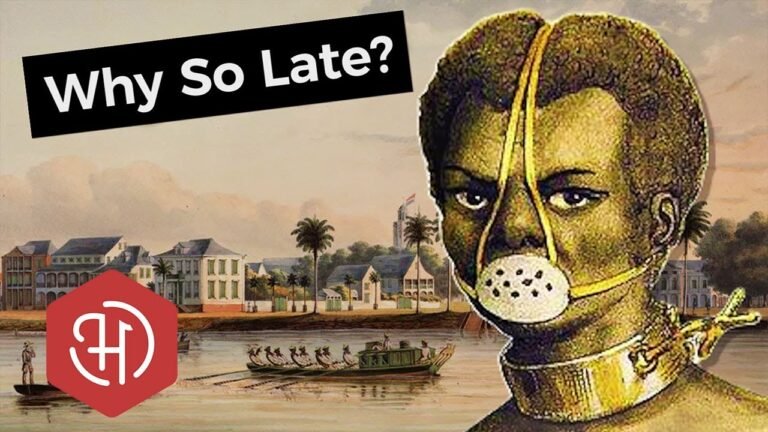
Why did the Dutch abolished slave trade not until 1863. The Dutch West India Company (WIC) was important in Dutch history. The WIC transported many African slaves across the Atlantic Ocean in the so-called transatlantic slave trade. In the history of the Netherlands the Golden Age is a vital time for the rise of the Dutch Republic in the 17th century. The Dutch Golden Age (Gouden Eeuw) commensed when the Dutch provinces led by Holland were revolting against Spain in the so-called Dutch Revolt. In the Dutch history this revolt is also know as the Eighty Years’ War (Tachtigjarige Oorlog) and took place in the Low Countries. In 1588 the Dutch Republic (Republiek der Zeven Verenigde Nederlanden) was established. In 1621 the Dutch West India Company (WIC – West-Indische Compagnie) was established and brought great wealth to the Dutch Republic. Yet, many people suffered. An estimated 600,000 enslaved Africans were transported across the Atlantic Ocean on Dutch ships. Only in 1863 the Dutch abolished slavery, long after Spain, Great-Britain and France did. Why was this?
SUPPORT ME ON PATREON ►
SUPPORT ME ON PAYPAL ►
SUBSCRIBE ►
INSTAGRAM ►
FACEBOOK ►
TWITTER ►
SOURCES
– Geschiedenis van de Nederlandse slavenhandel (P.C. Emmer).
– Geschiedenis van Suriname. Van stam tot staat (Eveline Bakker, e.a.).
– Geschiedenis van Suriname (Hans Buddingh’).
– (02-12-2022).
IMAGES
Images from commons.wikimedia.org.
MUSIC
“Asian Drums” Kevin MacLeod (incompetech.com)
Licensed under Creative Commons: By Attribution 3.0 License
SOUNDS
Freesound.org.
E-MAIL
historyhustle[at]gmail.com
source
Learn about the Dutch Golden Age:
https://www.youtube.com/watch?v=RdLjM_sBV08
To answer your question regarding if any of us were aware that part of Brazil was controlled by the Dutch from 1630-1654. I actually was aware of this fact before watching this video. Good little bit of info though. The map you have for this video is quite lovely aswell.
Much love from Oregon U.S.A.
0:37 Spain did not abolish slavery in 1811
You're doing great work. Teaching us every thing that we didn't learn at school. We learned about slavery in Suriname, but not to this extent. Could you tell us more about the history of the Dutch East Indies?
The Dutch !? Or a tiny elite group of violent families whose offspring still lives in Splendor, while the rest of "the Dutch" don't really, especially culturally poor… There seems to be this massive confusion going ro und…
1873
Saudi Arabia abolished in 1963. Better late than never!
is it true that there are africans enslaving africans in 2022? Does anyone cover that? it is now!
Wel atleast they stoped !!
unlike africa ore big parts of the middle east and asia buth he there not white so than its ok
De golden age… The best thing that happend in Dutch history
Its still TERRIBLE here in Amsterdam.
Just recently, nationwide protests went to the streets complaining about NOT being allowed to do blackface black pete anymore.
And they are in the streets protesting the right to say Ngger and Nger. Can you imagine a group of white people, protesting FOR the RIGHT to use the Nword?
Also for some reason my fellow dutchies like to protest because they DONT want the minister to say sorry for slavery.
ther are alot of country s that still doing slavery mostly in the midden east
Totale schijtzooi natuurlijk, wij in het westen zijn een van de weinigen waar het überhaupt is afgeschaft. Hypocriet gedoe. Sowieso is het hele geneuzel over slavernij totale nonsense. De gehele mensheid handelde in en had al slaven zover de tijd terug gaat. Ieder kleur mens werd verhandeld, niet alleen zwart. Zwart verkocht zwart, en een Chinees verkocht een Japanner. Maar om altijd maar te doen alsof wij het westen en dan vooral de blanke man verantwoordelijk zijn voor slavernij. Zum kotsen.
Me, a moroccan, watching this video about the Netherlands "late" abolishion when my country only abolished black slavery in the 1920s and closed the last black slave market in the 1930s and doesn't even teach about it in schools and hope it's forgotten, so now although a third of thr country is of black slave descent they're clueless about the country's dark history.
In the u.s. , after emancipation, in primarily southern states, slavery continued on in the form of fascist- style terror and horror brought against black folk and anyone else who was not a white male. There is such hope tht tht someday the u.s. can become 100% democratic, and our govt is full of great people to help us reach tht goal, but the fascist element is still here.
Well if the Dutch tought me one argument to accept this sad fact. They did legalize gay marriages first . So lets forgive them right ?
Also the whole slavery is mixed in lies, they still fought Indonesia after the japanese got defeated. So after wo 2 they still used force to keep control aka slavery.
4:15 #blm #burnlootmurder #😂
4:35 they still are not enlightend in The Hague.
6:39
Middle class. Backbone of society. It is obvious why the modern politicians are destroying middle class at this moment. To make serfdom great again.
The clickbait picture looks like sylvana simons.
Slavery in Dutch Indonesia continued after that. Dutch historians just revleaed that slavery in Indonesia was bigger there then in the West Indies and Suriname
Omdat we een dom volk zijn
Well because our slaves didn't deserve to be free. Proven by the filth in our prisons even today.
To be fair didn't we try to still take political control in indonesia around 1950? Like wasnt Indonesia technically the last place we really had a colony?
At that point in time the normal people in the Netherlands had no voice 96 % was a semi slave on the land owners farm , first time for the normal men to vote was 1917 and for women 2 years later , so the People of The Netherlands have no stake in this most of them never heard of Africa let alone seen a black person , pls go to the owners of the West India Company Gr Gerard
Note: the west african slave traders were black.
I am learning Dutch now. The vowel pronunciation is killing me.
I don’t see how you could call this late. Because you compare it to other European Great Powers? European countries were the first in the world to abolish it. Not just that, we along with the British fought wars to end slavery in other countries.
Welke personen hebben aan de slavernij daadwerkelijk verdiend? en hebben daadwerkelijk hieraan meegewerkt?
Is there also information about slavery inside the netherlands itself ?
From the information you give i assume that a lot of people didnt realise how bad it was untill those books where published and people properly informed.
Or was it already pritty commen knowledge how horrible these people where treated ?
Too bad we stopped slave trade. We made lots of money of that. No need to say sorry everybody did it. Where do you think we bought them from? Yup black people. We were just facilitating the market.
2022, Louisiana voted over slavery and kept it legal.
Late? It was 10:00 AM.
Because until less than a century before it was the default around the world and when Europe finally dropped it they were like "Meh, might as well."
In 1812 the slave trade was abolished in the Netherlands and it took another 50 years for normal regular people to completely abolish the slavery.
Britain abolished the slave trade on 25 March 1807
"Most Dutch ships sailed to Suriname, which was a colony in the north of Latin America"…while pointing at a map of South America. I'm sure this is interesting content, but I have no tolerance for ignorance. The north frontier of Latin America is Mexico…
late FOR EUROPEAN standarts
It was'nt abolished in Mauretania until 1982. But Mauretania is African and moslem and consequently exempt from all negative comment.
They lost the customers aka the rich ppl in the USA
On September 22, 1862, Lincoln issued a preliminary emancipation proclamation, and on January 1, 1863, he made it official that “slaves within any State, or designated part of a State…in rebellion,… shall be then, thenceforward, and forever free.
I know nowadays putting context to the subject of slavery is not acceptable, polarizing the discussion is in fashion. But as a historian, I cannot help myself. In the video, I missed some context.
Firstly: The Dutch were only late compared to other Europeans, and there were only the British, Danes and French. All relatively small slaveholders compared to the USA and Brazil. In 1863 there were almost 4 million enslaved people in the US and 1.5 million in Brazil. The 13th amendment ending slavery in the US is from January 1865, in Brazil the last slaves were freed on May 13, 1888. So, it seems a bit Eurocentric to compare European countries, while the vast majority of enslaved were freed years later than in the European colonies, in Brazil even a generation later.
Secondly: Dutch slavery was not as black-and-white as suggested, even by the Dutch government. Already in the 17th century, most of the personnel of the WIC on Curaçao consisted of foreigners and free Africans. In Paramaribo, the capital of Suriname, 65% of the “people of colour” were free, artisans and not poor. Some of them even had slaves. And when the Dutch finally abolished slavery in 1863, this group was almost as big as the group of enslaved people. A similar development was seen in Brazil, although there were large regional differences.
Thirdly: Slavery did not start in European (former)colonies and didn’t end there. The North African country of Mauretania formally abolished slavery only in 1981, Saudi Arabia in 1962 and in China it existed until 1949, just to mention a few.
Slavery is a despicable institution and was part of most cultures throughout history. In 2023 we still must fight slavery and cultures that approve of it. We can only do that if we look at our history with an open mind, without activism or political agendas.
If I were Dutch, I certainly wouldn’t feel particularly guilt stricken about that date. As we all know, slavery was quickly reimposed on Black Americans post – Reconstruction, associated with ‘ Jim Crow ‘ laws, the share cropping system , segregation nation -wide, ‘ race riots ‘, and more.
I mean whoops.
It still was a long time ago tho, please don't hate us.
One essential element was that Dutch slavery happened far away from the home land with many foreign sailors and employees involved. It is easy to get away with evil if those that regulate you are not touched or involved, but do get the benefits.
I also always find it important to point out trade with our former colonies is currently way, way more profitable (to both sides) than it ever was during the colonial and slavery periods. Colonies has a poor population so they couldn't buy anything and the low labour costs resulted in massive overproduction reducing profits in Europe.
Never forget the VOC went bankrupt! In the end the Dutch colonies were as much a pyramid scheme as the South Sea Company was with only the early investors and upper class still benefitting.
as a dutch person, it wasnt late at all, way too early if you ask me.
Define 'late'? There were still countries who only abolished the practice after WW2..
No forgiveness!
Educating video. What about a video on the enslavement of white Europeans (&sub-Sahara Africans) by North Africans under Ottoman rule? Or the Arab slave trade in East Africa? Or the actual continuation of slavery today in Mauretania, Libya, Sudan, Saudi Arabia and Lebanon? Or most interesting; the enslavement of West Africans by West Africans and their trade of fellow African with European buyers?
Imagine how the planet would look like without slavery ? because it has grown the world's economy and continues to thrive on it.america or the us were still a place with natives and the dutch Would look polder-like with many dikes and water.. Is hard fact but the reality